
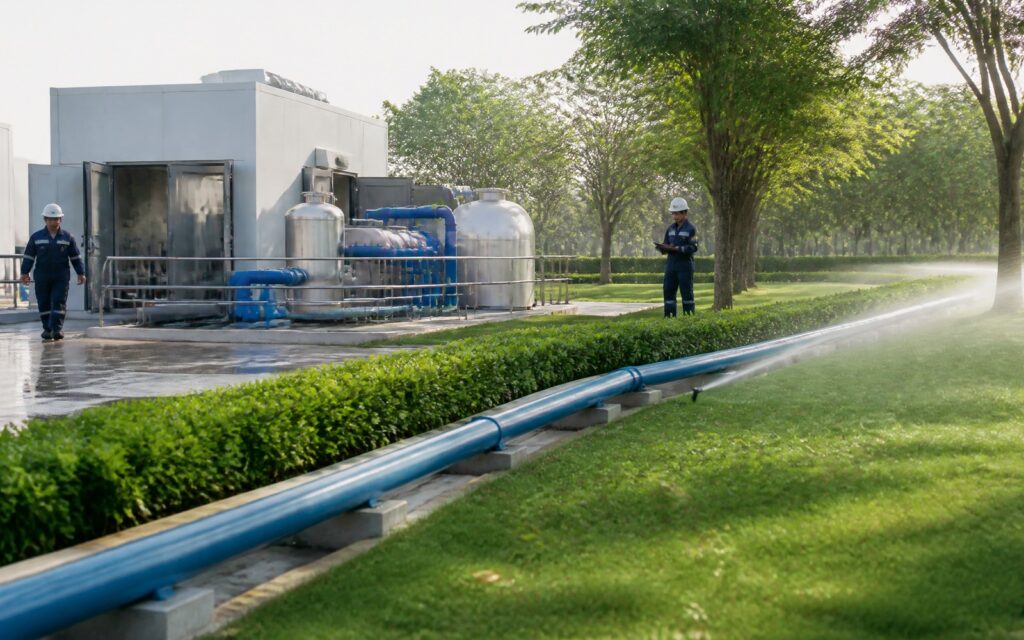
Treated Water Reuse (Landscaping/Irrigation) Solutions
Develop sustainable solutions by reusing treated water for landscaping and irrigation. Discover the potential of this sector, from municipalities to farms.
Get free consulting for your Treated Water Reuse (Landscaping/Irrigation) project
Reusing treated water is gaining increasing importance, particularly in the fields of landscaping and irrigation. Climate change and the reduction of water resources make it essential to use water more efficiently. Many institutions and companies such as municipalities, agricultural enterprises, landscape architects, golf courses, university campuses, hotels, industrial facilities, sports complexes, housing projects, and environmental engineering firms are seeking solutions related to the reuse of treated water.
Municipalities can reduce costs and contribute to environmental sustainability by using treated water for the irrigation of green spaces. Agricultural enterprises can enhance efficiency by integrating treated water into irrigation systems and reduce dependency on natural water resources. Landscape architects can create more eco-friendly designs by utilizing treated water in their projects. Other players in this sector can also benefit from similar advantages.
The reuse of treated water in landscaping and irrigation not only provides environmental benefits but also offers economic advantages. Golf courses and sports complexes can lower operational costs by using treated water to meet high water demands. Hotels and resorts can support sustainable tourism practices by irrigating their green spaces with treated water. Housing projects may prefer treated water to offer residents greener and more sustainable living areas.
These solutions not only save water but also reduce the environmental footprints of communities. Environmental engineering firms play a critical role in the planning and implementation of such projects. Furthermore, institutions with large areas, like university campuses, can set an example of sustainability in education and research by integrating treated water for landscape maintenance and irrigation.
The development of integrated systems for the reuse of treated water is a significant necessity for companies in this sector. These systems can be integrated into existing infrastructure and designed according to local regulations. This way, it contributes to the conservation of existing water resources and achieves long-term cost savings.
- Irrigation projects for parks and gardens for municipalities
- Integration of treated water into irrigation systems for agricultural enterprises
- Reuse of treated water projects for golf courses
- Irrigation landscape projects for university campuses
- Irrigation projects for green spaces for hotels and resorts
- Landscape maintenance projects using treated water for industrial facilities
- Water use optimization projects for sports complexes
- Green space irrigation solutions for housing projects
- Sustainable design projects for landscape architects
- Integrated system development projects for environmental engineering firms
- Treated water use projects for public spaces
- Irrigation landscaping projects for city squares
Example Project Scenario
A municipality aims to use treated water in the irrigation systems of urban parks. This project plans to evaluate the existing water infrastructure and integrate treated water. The project steps are as follows:
- Analysis of existing infrastructure and assessment of suitability for treated water use
- Planning for the supply and storage systems for treated water
- Modification of irrigation systems to operate with treated water
- Compliance with local regulations and obtaining necessary permits
- Implementation of the project and testing of the system
- Training staff and providing guidance for the effective use of the system
- Post-project assessment and presentation of improvement suggestions
The reuse of treated water for landscaping and irrigation purposes provides significant benefits in terms of both environmental sustainability and economic efficiency. The successful implementation of such projects requires expertise and experience. Relevant companies and institutions can collaborate in this process to develop the most suitable solutions.
By offering one-stop solutions, you can facilitate the reuse of treated water and contribute to a sustainable future. You can take the first step towards realizing your project by reaching out.
How We Can Help
Irrigation projects for parks and gardens for municipalities
Municipalities can reduce irrigation costs and conserve water resources by using treated water in parks and gardens.
Integration of treated water into irrigation systems for agricultural enterprises
Agricultural enterprises can use treated water in their irrigation systems to increase water efficiency.
Projects for the use of treated water in golf courses
Golf courses can use treated water to meet high water demand, which reduces costs.
Landscape irrigation projects for university campuses
University campuses can use treated water in landscape irrigation to align with sustainability goals.
Irrigation projects for green areas for hotels and resorts
Hotels can support sustainable tourism practices by irrigating their green areas with treated water.
Landscape maintenance projects using treated water for industrial facilities
Industrial facilities can reduce their environmental footprint by using treated water for landscape maintenance.
Water use optimization projects for sports complexes
Sports complexes can optimize water consumption and reduce costs by using treated water.
Irrigation solutions for green areas for residential projects
Residential projects can use treated water to provide sustainable living spaces for their residents.
Sustainable design projects for landscape architects
Landscape architects can create eco-friendly designs by using treated water in their projects.
Integrated system development projects for environmental engineering firms
Environmental engineering firms can develop integrated systems for the use of treated water.
Projects for the use of treated water in public areas
Using treated water in public areas can save water and increase environmental sustainability.
Landscape irrigation projects for city squares
Using treated water in city squares makes the maintenance of green areas more sustainable.
Which of these solutions fits your Treated Water Reuse (Landscaping/Irrigation) project?
Get a free initial assessment and we'll identify the right solution for your project. We reply within 24 hours.
Frequently Asked Questions
How long can treated water be used for landscaping and irrigation?
It can vary depending on the scope of the project. Generally, it can be implemented within a few months, and results can be seen immediately.
What is the cost of the project?
The cost depends on the size and scope of the project. A detailed cost analysis is recommended before implementation.
What permits are required for the use of treated water?
Compliance with local regulations and obtaining the necessary permits is important. Consulting on this matter should be done at the beginning of the project.
How is the project initiated?
The first step is to analyze the existing infrastructure and determine the needs. Then, appropriate solutions are developed and a plan is made for implementation.
How is the quality of treated water ensured?
Quality is ensured by the treatment technologies used. Regular testing and maintenance guarantee the continuity of water quality.
What are the advantages of using treated water?
It saves water, reduces costs, and contributes to environmental sustainability. Additionally, it decreases dependence on natural water resources.
Which sectors is this project suitable for?
It can be applied in a wide range such as municipalities, agricultural enterprises, golf courses, hotels, and university campuses.
How is system integration done?
Existing irrigation systems are modified to work with treated water. It is recommended to seek expert support during this process.
What are the long-term benefits of using treated water?
In the long term, it contributes to the conservation of water resources, saves costs, and supports environmental sustainability.
Request a Quote for Your Project
Our experts are ready to design a solution around your requirements.
Contact Get in Touch Our projects →Related Services
Related Guides
Guides on setup, costs and regulations
-
 How to Set Up a Cocoa Powder Production Facility?
How to set up a cocoa powder production facility? In this guide, we discuss the processes for cocoa…
Read more
-
 Steps for Feed Seawater Analysis and Process Design
Learn step by step how feed water analysis and process design are carried out in seawater treatment plants.…
Read more
-
 How to Set Up a Capsule Production Line?
A detailed guide on setting up a capsule production line. We focus on equipment selection, integration processes, GMP…
Read more
-
 How to Set Up a Baby Food Production Factory?
How to set up a baby food production factory? A detailed guide on setup steps, hygiene standards, and…
Read more