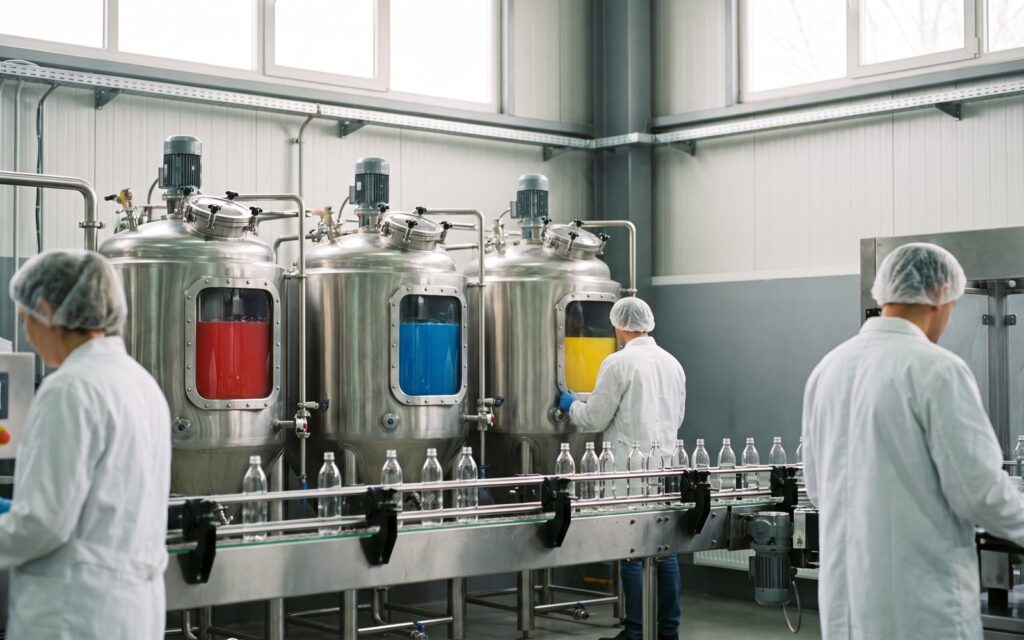
Establishing food coloring production facilities is a complex process, especially for entrepreneurs looking to operate in a sector where food safety and quality standards are strictly enforced. The setup of such facilities involves not only the physical construction of the production line but also operating in compliance with food safety laws and regulations. In this article, we will provide a detailed guide on how to set up food coloring production facilities.
You can review the services we provide, from design to commissioning, on our Food & Beverage Sector page.
Sectors and Products Covered
Food coloring production facilities are critical for companies operating in various areas of the food industry. The products produced in these facilities are generally used in the food, beverage, cosmetic, and pharmaceutical sectors. Product forms include liquid and powder food colorings, gel colors, and capsule colors. Food colorings are commonly used in various food products such as confectionery, beverages, baked goods, and dairy products.
Process of Setting Up Food Coloring Production Facilities
The process of setting up a food coloring production facility involves a series of complex steps. First, it is necessary to determine the region and area where the facility will be established. At this stage, selecting a site that complies with local regulations is critical for the future operational success of the facility. Factors such as the logistical advantages of the region, ease of transportation, and availability of raw materials should also be considered.
Next, the design and planning of the facility must be carried out. This stage requires a customized design based on production capacity, product diversity, and production processes. Additionally, Turnkey Production Facilities services can provide significant convenience in this process. This service encompasses all stages from the design of the facility to its construction, equipment selection, and installation.
Following the facility design, the selection and procurement of necessary machinery and equipment are carried out. The equipment to be used in food coloring production must be suitable for the production capacity and product diversity. At this stage, the energy efficiency and maintenance requirements of the machines should also be considered. Automation systems and advanced technology equipment should be preferred to increase the efficiency of the production line.
Another important step in the installation process is the integration of quality management systems. These systems are necessary to ensure quality at every stage of the production processes. In food coloring production, compliance with HACCP (Hazard Analysis and Critical Control Points) and GMP (Good Manufacturing Practices) standards must be ensured. These standards ensure that products are produced safely and of high quality.
Finally, the necessary permits must be obtained for the facility to become operational. These permits should be obtained from local authorities and cover issues such as environment, health, and safety. Considering that the permit processes can be time-consuming, sufficient time should be planned for this stage.
Requirements and Standards
There are specific standards and requirements that must be adhered to during the establishment of food coloring production facilities. First and foremost, the facility must comply with HACCP and GMP standards in all production processes. These standards are established to ensure product safety and protect consumer health. Compliance with these standards must be maintained at every stage of the production processes.
Additionally, it is important for the facility to comply with environmental regulations. Production processes and waste management systems that do not harm the environment are critical for the sustainability of the facility. In this context, the use of technologies that minimize water and energy consumption is encouraged. The use of renewable energy sources reduces environmental impacts and lowers operating costs.
Regulatory compliance is one of the most important requirements for food coloring production facilities. Compliance with local and international regulations increases the facility’s competitiveness in the market while also preventing legal issues. Therefore, continuous regulatory monitoring and updates must be ensured.
Costs and Timeline
The installation costs of food coloring production facilities vary based on the size of the facility, production capacity, and type of equipment used. Costs generally consist of land acquisition, construction, equipment procurement and installation, and integration of quality management systems. Additionally, personnel training and startup operating expenses are also among the cost items.
The time required for the facility’s installation can vary depending on the scope and complexity of the project. Generally, the installation of a turnkey facility can take anywhere from a few months to a year. During this process, creating a detailed timeline and coordinating with all stakeholders is crucial for the successful completion of the project. A flexible timeline should be prepared to account for possible delays that may arise during the process.
Common Mistakes
One of the common mistakes in the establishment of food coloring production facilities is starting the project without sufficient planning and research. Issues such as non-compliance with legal regulations and insufficient integration of quality management systems in production processes can negatively impact the success of the business. Such mistakes can lead to significant losses in terms of both time and cost.
Another common mistake is the inaccurate calculation of costs, leading to budget overruns. In such projects, it is important to leave a margin for unexpected expenses and continuously monitor costs. In addition to financial planning, regular monitoring of cash flow is also necessary.
Moreover, personnel training and management are often overlooked. It is essential for the personnel working in production processes to be adequately trained in quality management systems and safety standards to operate the facility efficiently and safely. Regular updates of training programs and contributions to the continuous development of employees are important.
Additionally, mistakes made in supply chain management can negatively affect the operational efficiency of the facility. Delays or quality issues in raw material supply can disrupt production processes. Therefore, it is important to work with reliable suppliers and manage the supply chain effectively.
Related guides: How to Set Up a Cocoa Powder Production Facility?, How to Set Up a Baby Food Production Factory? and How to Establish Vegetable Oil Production Facilities?.