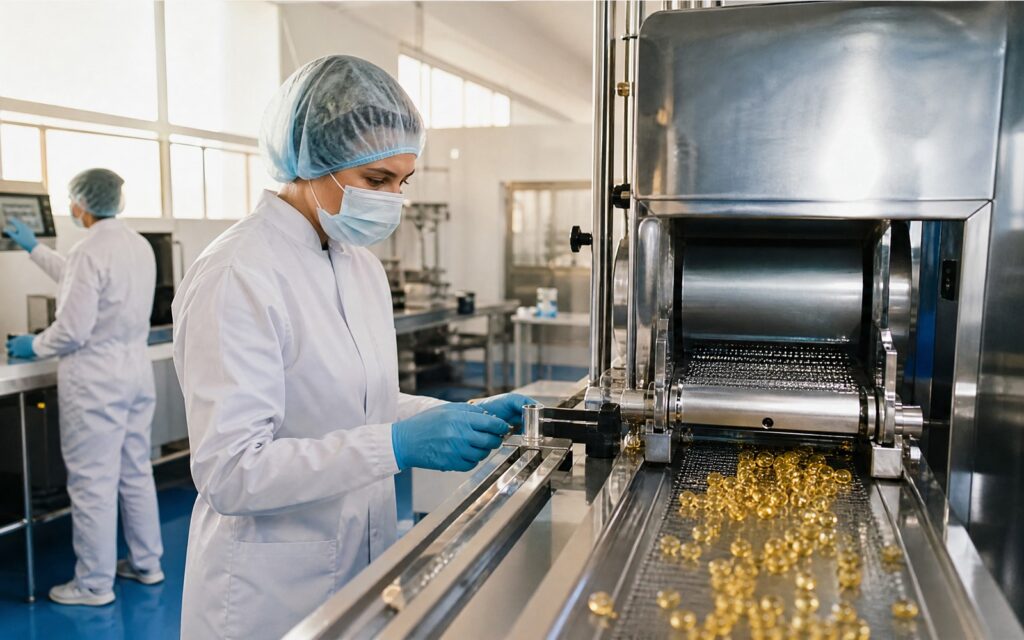
Soft gel production factories hold significant importance, especially in the pharmaceutical and dietary supplement sectors. These facilities must not only ensure the mass production of high-quality products but also comply with strict regulatory requirements. Setting up a soft gel production factory involves not only the construction of a physical facility but also the establishment of a quality management system, regulatory compliance, and a structure ready for inspection.
Industries and Products Covered
Soft gel production factories serve various industries. The main sectors include pharmaceuticals, dietary supplements, and veterinary medicines. The product diversity is quite broad and can be listed as follows:
- Vitamin and mineral supplements
- Omega-3, fish oil capsules
- Soft gels containing herbal extracts
- Pharmaceutical drug capsules
- Special formulations for veterinary use
These products are typically produced through manufacturing processes that require high precision and strict quality control measures.
Soft Gel Production Process
The soft gel production process includes several critical stages. First, the formulation development stage occurs. In this stage, the content and formulation of the product are determined. Then, the necessary equipment and infrastructure for production are planned. At this stage, the turnkey production facilities approach provides significant advantages.
Formulation Development
This stage is crucial for ensuring the efficacy and safety of the product. During the formulation development process, the selection of active ingredients and their combination with suitable carriers is ensured. R&D studies and pilot production tests are conducted at this stage.
Production Planning and Equipment Selection
Production planning begins with determining capacity requirements and selecting appropriate equipment. The design of the production line is supported by process optimization and efficiency-enhancing measures. When selecting equipment, GMP compliance and adherence to HACCP standards should be considered.
Regulatory Requirements and Standards
Regulatory compliance in soft gel production is critical for both product safety and legal requirements. Good Manufacturing Practices (GMP) and Hazard Analysis and Critical Control Points (HACCP) standards must be applied at every stage of the production process.
GMP and HACCP Practices
GMP ensures that production processes are managed in a way that guarantees quality. This is important for both product safety and customer satisfaction. HACCP provides a framework for identifying potential hazards and controlling these hazards.
Cost and Time Management
The cost of setting up a soft gel production factory can vary based on many factors. These include the size of the facility, production capacity, type of equipment, and regulatory requirements. CAPEX (Capital Expenditures) and OPEX (Operational Expenditures) must be carefully planned.
CAPEX and OPEX Planning
CAPEX covers the expenses necessary for initial investments. This includes building construction, equipment purchase, and infrastructure setup. OPEX refers to the expenses required to maintain the daily operations of the facility. These include personnel salaries, maintenance costs, and energy expenses.
Common Mistakes and Considerations
Common mistakes encountered in the setup of a soft gel production factory often stem from deficiencies in the planning stage. For example, a lack of understanding of regulatory requirements or insufficient emphasis on process optimization can lead to significant costs. Additionally, inadequate capacity planning can make it difficult to respond to increases in demand.
Therefore, it is important to obtain experienced consulting services during the facility setup process and conduct a detailed feasibility study. You can find more information on our production facilities page.
Softgel production factory: step-by-step production process
The steps below summarise the typical workflow we follow in softgel production factory projects. In every project the sequence is adapted to the product portfolio and the capacity target.
- Product definition: whether the product will be a food supplement or a medicine, the shell type (bovine or fish gelatine, or plant-based alternatives) and the fill formula are defined.
- Gelatine mass preparation: gelatine, plasticiser and water are melted under vacuum and the consistency is checked.
- Fill preparation: the oil-based fill is mixed, homogenised and de-aerated.
- Encapsulation: a rotary die machine forms gel ribbons and joins them with the fill to shape the capsule.
- Drying: capsules reach target hardness in tumble dryers and then in humidity-controlled drying rooms.
- Inspection and polishing: defective capsules are removed and surface oil is cleaned off.
- Packaging and quality release: bottle or blister packaging, batch testing and release.
Key equipment and systems
Equipment is selected according to the formulation, target capacity, level of automation and cleaning validation requirements. A typical facility includes the following main groups:
- Gelatine melting tanks and vacuum systems
- Fill mixing and homogenisation vessels
- Rotary die encapsulation machine and die sets
- Tumble dryers and humidity-controlled drying rooms or tunnels
- Capsule sorting and visual inspection equipment
- Bottle filling or blister packaging line
- HVAC and dehumidification for low humidity
GMP and regulatory notes
If softgels are produced as food supplements, the facility needs food business registration or approval under the local food authority, HACCP and ideally an ISO 22000-based food safety system; in the EU, Directive 2002/46/EC sets the framework for supplements. If they are produced as medicines, the site must meet pharmaceutical GMP. Where halal or vegetarian certification is needed for target markets, the shell material must be chosen accordingly.
How is the project timeline planned?
Installation time depends on variables such as whether the building is ready, lead times for imported equipment, cleanroom requirements and the workload of licensing authorities. Rather than quoting a fixed duration, we split the project into clear phases and define the deliverable of each one:
- Feasibility and definition of the product portfolio
- Concept and detailed engineering (layout, personnel and material flows, HVAC and process water)
- Equipment procurement and construction works
- Installation, commissioning and qualification (DQ, IQ, OQ, PQ)
- Process validation, documentation and licensing
- Staff training and transition to commercial production
When work that can run in parallel (for example equipment orders and construction) is planned correctly, the overall schedule shortens noticeably. The critical path is usually long-lead equipment and official approvals.
Factors that drive the cost
Every investment budget is different; the items below have the greatest impact on total cost:
- Number and capacity of encapsulation lines
- Size of the drying area and dehumidification capacity
- Product type: food supplement or medicine (GMP scope)
- Shell material and special formulations (plant-based, chewable, etc.)
- Packaging formats and automation
- Laboratory and stability testing
At Envora we quantify these items for your specific project during the feasibility stage and also evaluate options for phasing the investment.
Frequently Asked Questions
Why is humidity so important in softgel production?
The gelatine shell absorbs and releases moisture; if drying and storage conditions are not controlled, capsules can stick, deform or drift out of the hardness specification. Drying and packaging areas are therefore designed for low humidity.
Can plant-based (vegan) softgels be produced?
Yes; there are alternative shell systems based on starch and carrageenan. Process parameters differ from gelatine, however, and the suitability of the equipment should be verified at the design stage.
Does Envora offer turnkey installation?
Yes. We can manage the entire process under one contract, from feasibility, concept and detailed engineering to equipment supply, installation, qualification and staff training. Consulting-only or engineering-only packages are also available.
Can an existing building be converted into a production facility?
In most cases it can. We assess ceiling height, floor load capacity, utilities and the space available for personnel and material flows on site, and then decide together whether refurbishment or a new building is the better option.
Contact our team to have your project assessed and to receive a roadmap tailored to you. You can find the details of our scope on the Nutritional Supplement Production page.
Related guides: How to Set Up Capsule Filling Production Facilities?, How to Establish a Herbal Supplement Production Factory? and How to Establish a Food Supplement Production Factory?.